Sunday, August 14, 2011

Latest List of Tamil Nadu Ministers

Council of Ministers


Selvi J Jayalalithaa

Chief Minister


Public, Indian Administrative Service, Indian Police Service, Indian Forest Service, General Administration, District Revenue Officers, Police, Home.


Thiru O. Panneerselvam

Minister for Finance

Finance, Planning, Legislative Assembly, Elections and Passports.


Thiru K.A. Sengottaiyan

Minister for Agriculture

Agriculture, Agricultural Engineering, Agro Service Cooperatives, Horticulture, Sugarcane Cess, Sugarcane Development and Waste Land Development.


Thiru. Natham R. Viswanathan

Minister for Electricity and Prohibition and Excise


Electricity,Non-Conventional Energy Development, Prohibition and Excise, Molasses.


Thiru K.P. Munusamy

Minister for Municipal Administration and Rural Development


Municipal Administration, Rural Development, Panchayats and Panchayat Unions, Poverty Alleviation Programmes, Rural Indebtedness, Urban and Rural Water Supply.


Thiru C. Shanmugavelu

Minister for Rural Industries


Rural Industries including Cottage Industries and Small Industries.


Thiru R. Vaithilingam

Minister for Housing and Urban Development

Housing, Rural Housing and Housing Development, Slum Clearance Board and Accommodation Control, Town Planning, Urban Development and Chennai Metropolitan Development Authority

Thiru Agri S.S Krishnamoorthy

Minister for Commercial Taxes and Registration

Commercial Taxes and Registration and Stamp Act


Thiru C. Karuppasamy

Minister


Thiru P Palaniappan

Minister for Higher Education

Higher Education including Technical Education, Electronics, Science and Technology.


Thiru C.Ve Shanmugam

Minister for School Education, Sports and Youth Welfare

School Education and Archaeology, Sports and Youth Welfare.


Thiru Sellur K Raju

Minister for Cooperation

Cooperation, Statistics and Ex-Servicemen Welfare


Thiru K.T Pachamal

Minister for Forests

Forests and Cinchona.


Thiru Edappadi K Palaniswami

Minister for Highways & Minor Ports


Highways and Minor Ports.


Thiru S.P Shanmuganathan

Minister for Hindu Religious and Charitable Endowments


Hindu Religious and Charitable Endowments (HR & CE), Tamil Official Language and Tamil Culture.


Thiru K.V Ramalingam

Minister for Public Works

Public Works , Irrigation including Minor Irrigation, Programme Works


Thiru S.P Velumani

Minister for Industries

Industries, Steel Control, Mines and Minerals, and Special Initiatives


Thiru T.K.M Chinnayya

Minister for Environment

Environment and Pollution Control


Thiru M.C Sampath

Minister for Special Programme Implementation

Implementation of Special Programmes including implemenation of the Election manifesto.

Thiru P. Thangamani

Minister for Revenue


Revenue, District Revenue Establishment, Deputy Collectors, Weights and Measures, Debt Relief including legislation on Money lending, Chits, Registration of Companies.


Thiru G. Senthamizhan

Minister for Information, Law, Courts and Prisons

Information and Publicity, Film Technology and Cinematograph Act, Stationery and Printing and Government Press, Law, Courts and Prisons, Personnel and Administrative Reforms and Prevention of Corruption


Thiru P. Chendur Pandian

Minister for Khadi and Village Industries

Khadi and Village Industries Board, Bhoothan and Gramadhan.


Tmt S Gokula Indira

Minister for Tourism


Tourism, Tourism Development Corporation.


Tmt Selvi Ramajayam

Minister for Social Welfare

Social Welfare including Women's and Children's Welfare, Nutritious Noon Meal, Orphanages and Correctional Administration, Integrated Child Development and Beggar Homes, Welfare of the Differently abled and Social Reforms.


Thiru B.V Ramanaa

Minister for Handlooms and Textiles

Handlooms and Textiles


Thiru R.B Udhayakumar

Minister for Information Technology

Information Technology


Thiru N Subramanian

Minister for Adi Dravidar and Tribal Welfare

Adi Dravidar Welfare, Hill Tribes and Bonded Labour.


Thiru V Senthil Balaji

Minister for Transport

Transport, Nationalised Transport, Motor Vehicles Act.


Thiru K.A Jayapal

Minister for Fisheries

Fisheries and Fisheries Development Corporation


Thiru Budhichandhiran

Minister for Food

Food, Civil Supplies, Consumer Protection and Price Control.


Thiru S.T Chellapandian

Minister for Labour

Labour, Population, Employment and Training, Newsprint Control, Census and Urban and Rural Employment.


Dr. V.S Vijay

Minister for Health

Health, Medical Education and Family Welfare.


Thiru N.R Sivapathi

Minister for Animal Husbandry

Animal Husbandry, Milk and Dairy Development.


Thiru A Mohammedjan

Minister for Backward Classes and Minorities Welfare

Backward Classes, Most Backward Classes and Denotified Communities, Overseas Indians, Refugees & Evacuees and Minorities including Wakf.


Monday, August 8, 2011

INSTITUTIONS OF HIGHER EDUCATION?


The Times of India

AARAK SHUN

Shobhan SaxenaShobhan Saxena, TNN
Aug 7, 2011, 05.09AM IST

AIIMSA knock on the door always makes Amit nervous. If it is daytime, he quickly moves the book rack so that it hides the framed photo of B R Ambedkar, dressed in a dark suit and looking at some distant horizon. If it's night, Amit lies still in bed, staring at the fan. As the banging goes on, he slips in and out of sleep. In his dreams he often sees a boy putting a noose around his neck. Sometimes he sees the boy hanging from a rope that's furiously twisting by itself. Then there is dead silence. He can't go back to sleep.

Amit, a student of IIT-Kanpur, is not suicidal. He has been to a shrink, though, and says he lives in some kind of dread. For two years, life on the campus was beautiful - at least until the day his classmates found out his caste, a fact he had masked with a caste-neutral surname. The Ambedkar photo had already made some "friends" suspicious, and when a clerk in the scholarship section "exposed" his caste, Amit's world changed. He lost his place on the dining table. The batchmates became hostile: jibes in the classroom or an accidental jab in the ribcage every now and then became a common occurrence. And the midnight knocks started. "They don't want me to study. People may think it's a seat of high learning but for me it's living hell," says Amit, who has a brilliant academic record. "People here don't believe in merit. They will push you if you perform better than them," adds the final-year student who is too scared to give his real name.

Amit is not paranoid. His fear is real. In 2008, the year he joined the institute, a fellow student called Prashant Kureel was found hanging in his room. In 2009, an MTech student, G Suman, killed himself. And in 2010, Madhuri Salve, a final-year student, used her dupatta to hang herself from the ceiling fan. All three were dalits and IIT authorities were quick to blame academic pressure for these deaths. "It's because of constant ragging and brazen casteism on the campus that my son killed himself," says Sunder Lal Kureel, the father of Prashant, as he continues his fight for justice.

But in this battle, Sunder Lal is alone. There are no middle class-led candlelight vigils at India Gate for Prashant. There are no campaigns by TV channels, just the lonely battle of a broken man. There are many like Sunder Lal in their peculiar tragedy. Since 2007, 18 dalit students pursuing engineering and medical courses in the country's top institutes, including the IITs and All India Institute of Medical Sciences, have committed suicide. And here's the real shocker: only one of them, Jaspreet Singh of Government Medical College, Chandigarh, left behind a suicide note. None of the others who hanged themselves or jumped from a building blamed anyone for pushing them to take the extreme step. "All of them had complained to their families about harassment at the hands of faculty and fellow students, yet they didn't leave a suicide note. Only Jaspreet's was there because his father found his body. We wonder what happened to all the other suicide notes," says Ratnesh Kumar of Insight Foundation, which is trying to get justice for the families. "We're sure the notes vanished because the victims had accused the authorities of harassment."

Hidden in these missing notes are the dirty secrets of India's top institutes, where dalits have been treated as outcastes ever since reservations were introduced for SC and ST students in the 1950s. Nobody likes to talk about this dark side. Now, as filmmaker Prakash Jha takes a "fresh look at the issue" with his Aarakshan, the dalits fear that the film may reinforce old biases. "We get only 15% seats, while the OBCs get 27%. But, it's the dalits who have to face the brunt of hate campaigns," says Surya Dev, a 25-year-old engineer from Guna, MP, who now works with the Insight Foundation helpline.

Ironically, anti-dalit sentiment erupted in 1991, when the V P Singh government decided to implement 27% reservation for OBCs. In the Capital's "Left-leaning" university, JNU, caste clashes took place between students; in the dining-halls of IIT-Delhi, dalits were forced to sit on separate tables, and the walls of urinals in Delhi University were covered with puerile graffiti. And the authorities just watched. "The atmosphere in our institutions is very brahminical as the upper castes dominate the faculty. In such an environment, the lower caste students automatically become outcastes," says Dilip Mandal, who teaches at Delhi's Indian Institute of Mass Communication (IIMC).

Many dalits have paid a price for being what they are. In 2008, Narendra Divekar and Nitin Kamble, who worked as cameramen at the Centre for Distance Engineering Education Programme at IIT Bombay, took part in a meeting of the institute's union for backward classes. A torrent of casteist abuses from the centre's web coordinator, Rahul Deshmukh, followed almost immediately. Deshmukh told them that they were "not fit to work here". A complaint was made to IIT authorities and the police. But the abuse went on. Unable to handle it, the duo tried to commit suicide outside Deshmukh's office.

Many, however, have fought back. Dr Ajay Singh, who joined AIIMS in 2002 with the same marks as the cut-off for "general" students, was the only dalit in his hostel wing. He was barred from entering the carrom-board room and one day someone scrawled "Nobody likes you here. F**k off" on his door. But Dr Singh fought back and that led to Prime Minister Manmohan Singh appointing a three-member committee, headed by University Grants Commission chairman Sukhdeo Thorat, to look into caste harassment in the country's top medical institutes. The report was shocking: dalit students were bullied into vacating their hostel rooms, leading to a ghetto being formed on two floors of a hostel; they were specifically targeted during ragging; they were not allowed to play cricket and basketball; they were not allowed to eat in the "upper-caste mess"; and the teachers ignored them in class, sometimes deliberately failing them in exams. Shamed by the damning report, AIIMS took some remedial steps. "Now the hostels are allotted through a lottery system and general harassment has come down a bit, but all the recommendations of the panel are yet to be implemented," says Dr Singh, who now works with a government hospital in Delhi.

But resistance is growing on some campuses. "Now the number of upper-caste and reserved category students is almost the same. It's not easy to bully them," says Mandal of IIMC. And dalits are now not prepared to be shunned by the system. "We started celebrating Ambedkar Jayanti on our campus to unite us," says Manju Kumari Rao, 28, a former student of Benaras Hindu University who was once denied permission to go abroad on an exchange programme because she was dalit. "We don't want to join the system, we want to change it."

(Additional reporting by Anahita Mukherji)


Sunday, August 7, 2011

We are relieved Bangladesh is not with Pakistan anymore - Tahmima Anam


'We're relieved Bangladesh isn't with Pakistan anymore'

Shobhan SaxenaShobhan Saxena, TNN
Aug 7, 2011, 12.38AM IST

A Golden AgeIn 2008, Bangladeshi writer Tahmima Anam , 36, talks about Islam, Bangladesh and its love-hate relationship with both India and Pakistan.In 2008, Bangladeshi writer Tahmima Anam , 36, won the Commonwealth Writers' Prize for her first novel A Golden Age, a stunning book that laid bare the gulf between East and West Pakistan during the 1971 war. In her second book, The Good Muslim, the London-based author returns to the period 40 years after Bangladesh won its independence to say that debates on Islamic fundamentalism are not just held in the western and Muslim worlds, but exist within Islam as well. In an interview with Shobhan Saxena , the Harvard-trained anthropologist talks about Islam, Bangladesh and its love-hate relationship with both India and Pakistan. Excerpts:

The title of the book suggests that there is something called a good Muslim. Who is a good Muslim?

The book is not supposed to answer this question; it's supposed to ask this question. The novel is meant to raise some questions in the reader's mind: who is a good Muslim? Is it the religious character? Is it the secular character? Or is it the mother who is caught between the two? I suppose that my aim was to show that these debates are happening between Muslim communities as well as between Muslim communities and the outside world. There are contestations of meaning and moralities - what it means to be a person of faith and to be a good person.

The backdrop of both your novels has been the 1971 war. Are Bangladeshis still talking about that war?

Yes, absolutely. I am a Bangladeshi writer and that's the most important thing that has happened and affected the world that still exists. This book is about the shadow of the war and about the people living in the wake of a great event. It's about the people who survive it - what happens to them; how they lead the rest of their lives knowing that they have lived through such a horrific time. For me, as a novelist, war is wonderful - it's like a stage where so many things happen, so many relationships change, and there is so much drama and trauma. There is love too. When I talk to people about the war, they don't say 'I fought this battle or that battle'; they say 'I went to the village for the first time and I fell in love'. You know the stories are very human. So I was attracted to that period.

So it's part of the imagination of your generation too - the people born and brought up after the war was over...

Definitely. It takes a big place in public imagination in Bangladesh - people of all generations whether they lived through it or not. There is a film called Guerrilla that released recently. It's a story of the war and shows all aspects of it - basically about the young men who formed the urban resistance. It's been playing to packed houses for three months and a lot of young people are going to see it because it's the first time they have seen this kind of cinematic depiction of what they have heard from their parents and read in books. There hasn't been a kind of closure to that event.

In 1971, India was seen as liberator of Bangladesh, but not anymore. What has gone wrong in these 40 years?

Well, there was a lot of goodwill after 1971. Indira Gandhi played a major role in our independence. Sonia Gandhi was in Dhaka last week and Indira Gandhi was given a big award. So there is still a lot of goodwill and a sense of indebtedness to India, to Indira Gandhi. Obviously, the relationship has had its ups and downs since then and there are many reasons for that. It's hard to be surrounded on three sides by a much bigger economic superpower. But there is a lot of potential for a relationship with a lot of mutual respect and understanding.

Recently, PM Manmohan Singh said something to the effect that many Bangladeshis support fundamentalism.

There is a mixed feeling about India. India can look at Bangladesh as its Muslim neighbour who doesn't have the problems of Pakistan - a Muslim neighbour that has nothing to do with ISI or fundamentalism and terrorism. The present government has done a lot in uprooting terrorism. India needs to acknowledge that and give Bangladesh its due. So, negative statements set the relationship back. People feel there goes India again - to bully us.

What kind of books do you read? Any favourite writers?

American writer Tony Morrison is my favourite. I also like a lot of contemporary Pakistani writers. I think the most exciting writing coming out of anywhere in the world is from Pakistan. Writers like Daniyal Muennedin, Mohammad Hanif and Nadim Aslam are writing excellent stuff. Indian writing in English is old now and a new generation of writers is coming up now from Pakistan, and hopefully, from Bangladesh. Maybe it's because of the many conflicts in that country. It's also because of the moment - it's Pakistan's moment on the world literary map.

There is a perception that Pakistan's at war with itself and may be falling apart. How do people in Bangladesh see what's happening in Pakistan?

We are all very happy that we are not part of Pakistan anymore. So there is a sense of relief. But because there is a feeling of Muslim countries being besieged by these stereotypes, there is a sense of camaraderie with other Muslim countries as well. And since Pakistan is one country which is most similar to ours, there is long-standing affection for Pakistan. Bangladeshis just adore the Pakistani cricket team. There is this kind of relationship but also the feeling that we didn't really belong together. It was a relationship that was doomed to fail.

Wednesday, August 3, 2011

AMBUR OPEN LEATHER EXHIBITION - AN IMPORTANT LEATHER INDUSTRY EVENT


AMBUR OPEN – AN IMPORTANT LEATHER INDUSTRY EVENT

V.M. Khaleelur Rahman

The second edition of “Ambur Open” exhibition organized by Indian Shoe Federation (ISF) and Indian Footwear Components Manufacturers Association (IFCOMA) on 9th and 10th of July 2011 at the magnificent Ambur Trade Centre, Ambur was highly successful according to many exhibitors and visitors. They felt that the exhibition being held as a permanent feature near the footwear hub of Ambur covering the entire area of Ambur, Vaniyambadi, Ranipet, Vellore, etc. is the right decision by the organizers. However the fact remains that it was possible as the result of the modern and majestic “Ambur Trade Centre” constructed in Ambur with the initiative taken by Ambur Economic Development Organisation (Aedol). The exhibition is recognized as an important leather industry event in our country. There was appreciation for the exhibition from the trade and industry as a whole.

Mr. M. Mohamed Hashim, Chairman, KH Group was happy about the organizational capacity of ISF, IFCOMA, Amburtec and other associations and stressed the need for being pro-active to garner a large piece of the global cake and investing substantially in the tanning sector to implement modernization schemes, improve productivity, rationalize labour policies, initiate excellence in designing skills and have more exporter friendly policies.

Mr. M. Rafeeque Ahmed, Chairmain, Council for Leather Exports, emphasized the need for maintaining a very high degree of competitiveness, quality and service at all levels to reap the benefits in the global market which is a world of opportunities in the midst of complexities, challenges, risks and uncertainties.

Mr. Sanjay Gupta, President, Indian Footwear Components Manufacturers Association, was happy to see the success of the Ambur Open exhibition. He said: “Our objective has always been to reach the footwear hubs of India so that the interactions between the buyers and sellers could be effective and result oriented catering to the needs and requirements of the industry at large and attain the broader perspective of the business.

Mr. P.V. Gopalakrishna Bachi, President, Indian Shoe Federation, said: Ambur Open is here to stay and we have striven to give you all a truly enriching and world class event. The components industry walks hand and hand with the footwear industry to meet the global challenges and the exacting quality requirements to meet international standards as well as to increase India’s share in the exports basket.

While Mr. N. Mohamed Sayeed, Chairman, Amburtec and President, Ambur Tanners Association was happy that the fair was well organized and the response tremendous and fully booked in advance, Mr. V.P. Naimur Rahman, Chairman, Indian Finished Leather Manufacturers and Exporters Association considered it as an excellent fair of international class and said that “the visionaries who conceived it deserve all our encomiums for putting this region on the global fair map”

The manufacturers of footwear components and accessories, tanners and shoe manufacturers had good time in the fair in meeting one another, discussing business possibilities and entering into contracts. Many felt that there is need for more and more co-operation among them to carry on trade and industry well maintaining standard and quality in their products in the highly competitive domestic and world markets.

According to available information the state of Tamil Nadu plays an important part in the development of leather and leather products industry of our country India. It is in the forefront with about 750 tanneries and the raw material processed per day is 500-1000 tons and annual turnover is more than Rs.10,000 crore. Tamil Nadu also enjoys the reputation of having 16 CETPs catering to 630 tanneries, 94 ETPs and more than 56 RO plants. No tannery operates without access to any effluent treatment plant and 100% connectivity to pollution control devices is a speciality of Tamil Nadu, according to All India Skin and Hide Tanners and Merchants Association.

These well established tanneries have contributed a lot in the establishment and development of 497 leather products units in Tamil Nadu producing about 59 million pairs of full shoes, 27 million pairs of shoe uppers, 7.1 million pieces of leather garments and 29.5 million pieces of leather goods.

The Ambur cluster has developed and is developing well adopting the progressive industrial policy of the government of India. The quality of various leathers and leather products produced in Tamil Nadu is of high standard and comparable with that of any advanced country. This is the reason why many world famous shoe giants like Fretz Men, Florsheim, Lumberjack, Gabor, Clarks, Hugo Boss and many others cover their requirements from here. The Ambur Open exhibition becoming a regular annual show at the Ambur Trade Centre – a symbol of industrial development in Tamil Nadu - is heartening to all. (Indian Leather, August 2011)

---------------------------------------------------------------------------------------------------------------------


Sunday, July 31, 2011

The Return of Mr Akbar Owaisi and his thanks giving speech


----- Forwarded Message ----
From: Pasha Patel <pashapatel74@gmail.com>
To: nrindians@googlegroups.com
Sent: Sun, 31 July, 2011 2:21:55 AM
Subject: [nrindians] The Return of Mr Akbar Owaisi

http://4tvtube.com/server/2011/07/news-at-400-30-7-2011/

The return to active political life by Mr Akbaruddin Owaisi, three months after the murderous attack on him, is nothing short of a divine miracle. It only reinforces and strengthens our faith in Allah, the Almighty. Mr Owaisi has himself acknowledged in his highly emotional first speech that he survived the deadly attack only because of the prayers of the hundreds of thousands of peace-loving Indians in general and Hyderabadis in particular.

On this happy occasion, we at NRIndians Group congratulate the entire Owaisi family and, in particular, Mr Akbar Owaisi's highly respectable uncle in Medina Mr Ahmed Owaisi and the honourable and popular MP of Hyderabad Barrister Asaduddin Owaisi.

Congratulations also to all those who stood on the side of peace and truth during these difficult moments. Alhamdulillah.

It must be said here and now that this not the time for recrimination. Now is the time for consolidation and reconciliation. It is the spirit of accommodation that should be the hallmark of Indian Muslims. Politics of revenge should not be promoted. Yes, the murderers should and must be punished and justice should not only be done but it should be seen to be done.

Do watch the entire video, the link for which was sent in by our honourable member Mr Aqil G. Mohammed, and pray for the well being of the First Family of the beloved city of Hyderabad. It is time for celebration and thanksgiving.

Pasha Patel
Owner and Moderator
nrindians@googlegroups.com


--
--~--~---------~--~----~------------~-------~--~----~--~--~---------~--~----~------------~-------~--~----~----~----~----~
1. The views/opinions presented in this email are solely those of the author and do not necessarily represent those of the group owners/moderators.
 
2. This group is for Indians and of Indians who take pride in India's secular and multi-cultural ethos. All of us are followers of Islam as preached and practised by the Last Messenger, Prophet Mohammed (peace be upon him).
 
3. This is a family group. Comments made herein are meant exclusively for the group members. Honourable members are, therefore, requested not to forward personal comments in this group to any third party/non-member, unless you have taken permission from the member.
 
4. Getting out of this group is easy. Just send a blank email to nrindians+unsubscribe@googlegroups.com.
-~----------~----~----~----~------~----~------~--~-----~--~---------~--~----~------------~-------~--~----~----~----~----~

Saturday, July 30, 2011

Fw: [nrindians] Deoband at the crossroads


----- Forwarded Message ----
From: MB Qasmi <manager@markazulmaarif.org>
To: markazulmaarif@yahoogroups.com
Cc: nrindians@googlegroups.com; Sent: Sat, 30 July, 2011 2:24:22 PM
Subject: [nrindians] Deoband at the crossroads

http://dailypioneer.com/356911/Deoband-at-the-crossroads.html


OPED | Saturday, July 30, 2011 | Email | Print | http://dailypioneer.com/images/Rating/stars4.gif| Back


Deoband at the crossroads
July 29, 2011 11:08:03 PM

M Burhanuddin Qasmi

Was Maulana Vastanvi's removal only for his alleged pro-Modi remarks? Saturday Special presents evidence that there was more to it than meets the eye

Darul Uloom Deoband is much more than a mere madarsa. It is a pile of history, a movement, an ideology itself; and mother of thousands of madarsas in the Indian sub-continent. Deoband is India's pride, a heritage; and it is nobody's monopoly. The power battle between Maulana Syed Arshad Madni and Maulana Ghulam Mohammad Vastanvi should not shake Deoband.

Maulana Mohammad Qasim Nanautavi (1832-1879), the founder of Darul Uloom (house of knowledge) at Deoband, later on outlined the purpose of establishing the institution in the following words: "The English have perpetrated boundless acts of tyranny against the Muslims for their fault, if at all it was a fault, of the uprising in 1857 and their relentless endeavour for the independence of this country thereafter. They have left no stone unturned to plunder and obliterate the Islamic arts and sciences, Muslim culture and civilisation. Endowments of Muslim educational institutions have been confiscated and as a result state funded schools have been virtually closed. It is therefore necessary to adopt other methods instead of relying upon the old system of endowments."

Deoband believes in inclusive nationhood, promotes patriotism and seeks equal justice. However, it is orthodox in following Islam in letter and spirit. After 1915, when Mohandas Gandhi returned from South Africa and with the help of the moderate group led by Ghokhale became president of the Indian National Congress, he formed an alliance with the Khilafat Movement and Deoband scholars-led Jamiatul Ansar - which later reformed as Jamiat Ulama-e Hind in 1919 to avoid a ban by the British Raj in 1913.

Since then, the Deoband scholars have had a strong political bonding with the Congress and it continued as late as 1990s — before the demolition of the Babri Masjid in 1992. During the pre-Independence era, when most 'modern' educated Muslims were trapped into the idea of nationhood based on religion — as articulated by Jinnah — Deoband scholars posed strong opposition. They unequivocally quoted from Islamic scriptures to prove that nationhood had nothing to do with religion. Rather, it has as its basis the idea one's birthplace and the sense of homeliness. They proclaimed Hindus and Muslim are one nation (qaum) and debated vigorously for composite nationalism, thus rejecting Jinnah's two-nation theory.

The first political comments in January by the nascent vice-chancellor or mohtamim of Darul Uloom, the 'liberal' Maulana Ghulam Mohammad Vastanvi, favouring Gujarat Chief Minister Narendra Modi would be a hard nut to digest for Deoband and her alumni; let alone giving a clean-cheat to Mr Modi or praising him. This author has also opposed his "statement" at that stage itself and it was printed in national newspapers. The basis of our opposition was that his statement angered Muslims across the globe. Moreover, in post-independent India, Deoband had shaped itself into an apolitical educational institute. The newly-appointed VC's amateurish media gimmick was quite uncalled for and caused unease in academic circles.

By July 23, our apprehensions got vindicated when the 'reformist' Maulana Vastanvi lost his battle in the face of some strong lobbying by Maulana Syed Arshad Madni and his supporters. Freedom of expression is a basic right in India — everybody knows it, but even iconic figures like Vastanvi should not have lost sight of the relationship between that right and responsibility. Maulana Vastanvi may have his personal likes and dislikes. But when he speaks as the Mohtamim of Darul Uloom Deoband, it mattered for many in India and abroad.

Nevertheless, it is a fact that there is more to Maulana Vastanvi's un-ceremonial removal from office than what meets the eye. His hurried dismissal was mired in a conspiracy by a certain interested class in Deoband and Delhi as the inflammatory coverage by certain Delhi-based Urdu newspapers following his appointment as Mohtamim of Darul Uloom bears out. Since the Congress top brass have almost unchecked intimacy with Vastanvi's arch rival, Maulana Arshad Madni, the long-handedness of the Congress cannot be overlooked. It, obviously, would be in the interest of the ruling party to keep Darul Uloom as her usual support bastion by ousting a person who could challenge absolute hegemony at any point of time — not to forget poll-bound Uttar Pradesh.

It is noteworthy that Maulana Ghulam Mohammad Vastanvi was elected by the high-level committee (Majlish-e Shoora) as VC of Darul Uloom on January 10, 2011 by a majority, even though voting was not common trends in the previous occasions in the history of the institute. Out of 18 members, 14 were present, Vastanvi secured eight votes while four favoured Maulana Arshad Madni and two voted for Maulana Abdul Khaliq Madrasi. Till that day, Maulana Vastanvi and Maulana Badruddin Ajmal, Lok Sabha member and president of All India United Democratic Front (AIUDF), were on top of the Arshad Madni fraction of Jamiat Ulama-e Hind.

Vastanvi's alleged Modi remark erupted just after his return from Deoband to Gujarat within days of his election. He was forced to call for an emergency meet of the Shoora committee on February 23. By then Maulana Ajmal was unconstitutionally sacked as president of the Assam State Jamiat by Maulana Arshad Madni — even though the State was election bound. Obviously it was an outburst against voting against the diktat. On February 23, the Shoora appointed a three-member sub-committee with Mufti Ismail of Malegaon as coordinator. Its term of reference was to investigate his alleged pro-Modi views with the context and submit a comprehensive report in the next Shoora meet.

To everyone's surprise, the next day Maulana Arshad Madni appeared before the media and mocked the Shoora decision. He announced: "He (Vastanvi) has got to go whether or not the three-member committee's findings favour him." He further emphasised, "he has (already) gone" and that the formation of a fact-finding committee was only a formality. Isn't this evidence enough that the decision on Vastanvi was taken by an extra judicial party and that too before the matter was put up for trial? The three-member probe committee had found nothing conclusive against Vastanvi. It is no secret that two of the three members, including the coordinator, stood with Vastanvi till the last day.

To say the least, no one is a saint in this mucky battle. Mufti Abul Qasim Banarasi, the new vice-chancellor appointed on July 23, is a good choice. He has a good academic and non-controversial carrier to his merit. Let us hope for a better and peaceful educational campus under his leadership. The nation's heritage, Deoband, must stand tall against all odds.

-- The writer is is editor of Eastern Crescent

--
--~--~---------~--~----~------------~-------~--~----~--~--~---------~--~----~------------~-------~--~----~----~----~----~
1. The views/opinions presented in this email are solely those of the author and do not necessarily represent those of the group owners/moderators.
 
2. This group is for Indians and of Indians who take pride in India's secular and multi-cultural ethos. All of us are followers of Islam as preached and practised by the Last Messenger, Prophet Mohammed (peace be upon him).
 
3. This is a family group. Comments made herein are meant exclusively for the group members. Honourable members are, therefore, requested not to forward personal comments in this group to any third party/non-member, unless you have taken permission from the member.
 
4. Getting out of this group is easy. Just send a blank email to nrindians+unsubscribe@googlegroups.com.
-~----------~----~----~----~------~----~------~--~-----~--~---------~--~----~------------~-------~--~----~----~----~----~

Monday, July 25, 2011

Maulana Ghulam Mohammed Vastanvi


darul uloom meeting.jpg

Darul Uloom Deoband : Maulana Ghulam Mohammed Vastanvi removed as Deoband Vice-Chancellor

Vastanvi axed as Darul V-C for praising Modi


Abantika GhoshAbantika Ghosh, TNN
Jul 24, 2011, 03.26PM IST

Darul Uloom DeobandGhulam Vastanvi removed as Deoband VC

See photoDEOBAND: His remarks about Gujarat chief minister Narendra Modi finally cost Darul Uloom vice-chancellor Ghulam Mohammed Vastanvi his job with the Islamic seminary's governing council Majlis-e-Shura sacking the cleric on Sunday.

The decision followed after Vastanvi refused to step down as he had initially promised in the February meeting of the council. Caretaker vice-chancellor Mufti Abul Qasim Nomani has now been made the new incumbent in the prestigious post ending seven months of drama over Vastanvi's comments that Muslims in Gujarat, like the state's other residents, had progressed under Modi's rule.

Vastanvi's remarks, first published in TOI, set off an uproar with his opponents closing ranks and his backers finding it difficult to support him despite the Gujarati cleric's clarifications.

Vastanvi went back on his promise on the ground that the inquiry report submitted by the three-member committee set up in February to examine allegations against him and also to probe those who fomented anti-Vastanvi protests was incomplete.

"The report failed to provide any insight into what or who was the trigger for the student unrest in Darul Uloom, so it is incomplete and I refused to quit on the basis of an incomplete report although I had said in February that I would quit irrespective of the contents of the report," Vastanvi said.

The sacked rector said the Shura passed a proposal to sack him by a vote of 8-4. "I am leaving Deoband for now but I continue to be a member of the Shura," Vastanvi said before leaving the sleepy Uttar Pradesh town which had a heavy police presence for the Shura meeting.

As Vastanvi's SUV left the guesthouse where the meeting was held, students from rooftops and on the streets cheered his removal. Some sections of the student community had been demanding his ouster vociferously.

Vastanvi had said in January that Muslims should move on from the Gujarat riots and the Modi government in Gujarat was doing a good job.

The inquiry report - which included clippings from TOI - gave Vastanvi a clean chit, admitted Shura member Abdul Alim Farooqui. "But he had promised he would quit so it was imperative that he did. That is why Shura decided to discontinue his services as the Mohtamim," Farooqui said. The cleric strongly opposed Vastanvi at the Shura meeting.

Vastanvi did suggest that politics and family interests might have played a role in his exit. Senior teacher Arshad Madani, who is Jamiat general secretary Mahmood Madani's uncle - the two are warring over control of the Jamiat and Deoband - has been active in the leadership tussle. So has Dhubri MP Badruddin Ajmal, a Shura member who has been one of Vastanvi's strongest supporters.

"I could have continued as Mohtamim but that would be detrimental to the interests of Darul Uloom as people with political leanings do not want me to work here. Darul Uloom is not the heirloom of some family. I have its best interests at heart so I do not want to be a roadblock in its progress," Vastanvi said.

Both the Madanis have been camping in Deoband. Ajmal though was one of the four who supported Vastanvi, the others including two members of the inquiry committee, Mufti Ismail and Mufti Ibrahim. Insiders said it was Mahmood Madani who finally swung things against Vastanvi. The proposal to sack Vastanvi was moved by acting VC Nomani.

Arshad has been one of the most strident critics of Vastanvi and it is said to be his opposition that was the primary reason for Vastanvi's woes. His position left Mahmood Madani with few options, locked as they are in a fight for control of the Jamiat.

Reiterating the impression that Vastanvi's fate had actually been sealed in the February Shura meeting itself when he had pleaded for an honourable exit and the inquiry committee was formed, Ismail said, "Our 15-page report was not considered at all. Why was the committee set up if Vastanvi's exit had been pre-planned?"

(Courtesy: The Times of India)


Maulana Ghulam Mohammed Vastanvi removed as Darul Uloom Chief

Vastanvi removed as Darul Uloom chief


Atiq Khan

Maulana Ghulam Mohammad Vastanvi was removed from the post of ‘Mohtamim' (Vice-Chancellor) of Darul Uloom, Deoband, on Sunday by the Majlis-e-Shoora, the powerful governing body of the institution.

The Maulana was voted out after he refused to step down, even as Shoora members insisted that he should stick to his February 23, 2011 statement that he would resign “irrespective of the findings of a probe committee.” But he maintained that the report was incomplete. The report of the three-member committee was submitted to the Shoora on Saturday.

Maulana Abul Qasim Nomani of Kanpur has been appointed the Vice-Chancellor.

The committee was formed on February 23, 2011, to investigate charges against Maulana Vastanvi, who had sparked a controversy by praising Gujarat Chief Minister Narendra Modi, after he took over on January 10, 2011, following the death of Maulana Marghoobur Rahman.

Maulana Vastanvi, an MBA and of Gujarat, had said at a function in his home State that like all other communities, Muslims too had progressed under the Narendra Modi rule, and that the Muslims should look beyond the post-Godhra communal riots and press ahead.

His statement was seen as an attempt at giving a clean chit to Mr. Modi. As violence broke out on the Darul Uloom campus and demands for his ouster became louder, he called for an emergency meeting of the Shoora for February 23, which set up the committee at his insistence.

The Shoora meeting on Saturday and Sunday was presided over by Maulana Ishtiyaq Ahmed of Bihar's Muzaffarpur.

Sources privy to the meeting said some Shoora members and Maulana Vastanvi exchanged sharp words after he refused to resign. “Aapko jo karna hai kijiye” (You can do whatever you want), he told them and left. He returned after 30 minutes and was told of the verdict. “Shoora ko yeh ikhtiyar hai jisko chaahe mohtamim banaye, jisko chaahe hataye” (The Majlis-e Shoora has the power to appoint Vice-Chancellor or remove him from the post), Maulana Nomani told The Hindu from Deoband on the phone.

“The Shoora's decision to remove Maulana Vastanvi was taken after he refused to quit and backed out of his statement that he would resign irrespective of the findings of the committee,” he said. Interestingly, Maulana Nomani was a member of the probe committee.

In fact, it was at the February 23, 2011 meeting that he was supposed to have resigned. “When the members present at meeting asked the Maulana to submit his resignation, he refused, insisting on the constitution of an investigation committee and saying he would wait for the panel's report,” said Maulana Nomani. Maulana Vastanvi had said whether the report went in his favour or against him, he would resign, Maulana Nomani recalled.

The committee's findings were based on evidence in the form of newspaper interviews of Maulana Vastanvi, pro-Vastanvi statements and anti-Vastanvi opinion. It also recorded the Maulana's statement. “The committee did not give any opinion, but left it to the Shoora to decide on Maulana Vastanvi's fate,” Maulana Nomani said.

(Courtesy: The Hindu)


"I am not going to any court. I accept the Shoora's decision," says Maulana Vastanvi


Thursday, July 14, 2011

The Terror Act in Mumbai is an Attack Against Our Nation


Press release


The Terror Act in Mumbai is an Attack Against Our Nation

AUDF president, Maul. Badruddin Ajmal


Mumbai, 14 July: "It is an act of terror, it is highly deplorable and a crime against humanity. No sane society would tolerate such repeated havoc on human life and property let alone any     religion." These were the reactions of Maulana Badruddin Ajmal, Lok Sabha MP and president of All India United Democratic Front (AIUDF), following serial bomb blasts in Indian's financial capital Mumbai last evening. The triple blasts in south and central parts of the city have succumbed 22 innocent lives and wounded around 150 common people on Wednesday between 6:45 to 7 pm was the third successive serial blast from 1993 and latest major terror strike against the city after 26/11 of 2008.


'Terrorism is a worldwide contagious ailment; it directly or indirectly affects all nations and every individual. The world has to face it with required sanity, unity and resolute strategy. The terror attacks in New Your, London and Mumbai must be taken equally by the world community. And similarly bomb blasts in Varanasi, Makkah Masjid, Malegaon and Mumbai must be viewed by the investigating and law enforcement agencies of India as just attacks against our nation.' "There must be zero tolerance for any kind of terrorism from any group or nation and the perpetrators must be brought to justice sooner than later" said Maulana Badruddin Ajmal.


Expressing their anguish over the dastardly serial blasts in Mumbai, Tarun Rathi AIUDF Mumbai Pradesh president and M. Burhanuddin Qasmi, AIUDF Maharashtra spokesperson, explicitly condemned the deplorable terror act and offered condolence to the families of those lost their lives or are injured laying in the hospital. They also appealed to the youths of Mumbai especially AIUDF youths to rush to the hospitals and donate blood where needed.


Maulana Ajmal who is also the president of Assam State Jamiat Ulama-e Hind said that the obvious target of such attacks is to instigate chaos in the country, create mistrust among friendly neighbours and ultimately weaken our nation. It is the duty of government of India to catch-hold of the real culprits, expose them and severely punish them. He strongly cautioned the Mumbai Anti Terrorism Squad (ATS) and the national media not to hurry towards any conclusion while identifying the criminals. Sometimes mere speculation and unhealthy discussions from media makes thing tougher for the government and agencies to do their work properly, he said.


AUDF president Maulana Ajmal also appealed to the Mumbaikers and the nation to maintain peace and harmony. He said, "It is our country and we all have a responsibility to defeat this anti national menace unitedly". He advised people to 'remain watchful, maintain peace and calm in all circumstances'. Shab-e Barat (the night of luck) is on this Sunday (17 July), Muslim should pray for the nation's unity and safety, Maulana Ajmal said.


--END—


Issued for immediate publication in print and electronic media by

M. Burhanuddin Qasmi

Spokesperson: All India United Democratic Front (AIUDF)

Patliputra Nagar, Oshiwara, Jogeshwari (West), Mumbai - 102

manager@markazulmaarif.org (Mob: 09820760545)


--
--~--~---------~--~----~------------~-------~--~----~--~--~---------~--~----~------------~-------~--~----~----~----~----~
1. The views/opinions presented in this email are solely those of the author and do not necessarily represent those of the group owners/moderators.
 
2. This group is for Indians and of Indians who take pride in India's secular and multi-cultural ethos. All of us are followers of Islam as preached and practised by the Last Messenger, Prophet Mohammed (peace be upon him).
 
3. This is a family group. Comments made herein are meant exclusively for the group members. Honourable members are, therefore, requested not to forward personal comments in this group to any third party/non-member, unless you have taken permission from the member.
 
4. Getting out of this group is easy. Just send a blank email to nrindians+unsubscribe@googlegroups.com.
-~----------~----~----~----~------~----~------~--~-----~--~---------~--~----~------------~-------~--~----~----~----~----~

Tuesday, July 12, 2011

SORCERY: Is it not a fraud on gullible Muslims to amass wealth?

SORCERY: Is it not a fraud on gullible Muslims to amass wealth? 


By V.M. Khaleelur Rahman


Chennai based Sana Nursary and Primary School celebrated its anniversary on 24th January 2010 and its boys and girls proved their mettle by enacting different programmes in English, Arabic and Urdu which were very much appreciated by people gathered there in good numbers. Maulana Mohammed Kaleem Siddiqui sahib was the Chief Guest. I heard his speech carefully and had an interview with him later. As his views are thought provoking, I want to share them with you. He said inter alia:


"A Muslim is bound to possess a thirst for knowledge and acquire it in different sciences including medicine, engineering, astronomy etc. There were great Muslim scientists in the past. The holy Quran asks us to research what is in the earth and on the skies - Tafakkaru fissamawati wal arz. Even learning a language different from ones mother tongue such as English which was neglected and its learning was considered Haraam on patriotic grounds when Muslims were involved in the freedom struggle is necessary now. It is very unfortunate that Muslim community is educationally and economically backward........" The Maulana exhorted the students and the people to seek more and more knowledge packed education. Asked if getting higher education is not necessary for women as sermoned by some ulema, he retorted that getting no education is haraam as it is against the Islamic diktat of "talabul ilmi fareezatun ala kulli Muslimin wa Muslimatin" ( Seeking knowledge is mandatory for all Muslims - men and women).


As regards "baddua" (cursing), he said that it is not permitted and our Pesh Imams should be careful about it. There is no permission in Islam to curse anybody. Sometimes we see our pesh Imams cursing in words like "allahumma shaththith shamlahum, allahumma dammir deyarahum". This is not correct. I have asked many to refrain from doing so."


He also pointed out to a question that putting hurdles in the way of good things being done (as was done in the case of Dr. Zakir Naik's Peace programme in Chennai) is against the letter and spirit of Islam. Difference of opinions can be discussed and sorted out and enmity should not be created among people. He honestly feels that there is no issue which cannot be solved by discussion in the light of the Quran and Ahaadeeth.


All the above and some other issues he discussed were appealing to me except his views on sorcery (sahar, jadoo tona ). A man approached the Maulana with his son and said that "some sorcerer has made his son ill mentally with the result that he behaves differently nowadays and puts us to troubles". The Maulana advised him to do some isthighfar like saying Subhanallah 100 times daily in the morning and evening. I asked him if any sorcerer can harm anybody without any contact just by reciting something or doing things, his hesitant reply was almost in the affirmative. This surprised me. I said if harming others is possible for the sorcerers, there will not be any direct attacks between one country and another and rulers like Bush and Saddam could have sought the help of sorcerers to finish or harm each other. The Maulana had no clear answer. Can anybody throw light on this vital subject and explain why people like me cannot reject the theory of sorcery as practiced now as absurd and fraud on the gullible people and nothing but exploitation to amass wealth


Sunday, July 10, 2011

"AMBUR OPEN 2 " LEATHER EXHIBITION 9TH AND 10TH JULY 2011

IMPORTANCE OF “AMBUR OPEN” EXHIBITION AND TAMIL NADU LEATHER INDUSTRY


V.M. KHALEELUR RAHMAN

A glittering “Ambur Open” exhibition of footwear components, accessories and finished leather being held jointly by Indian Shoe Federation (ISF) and Indian Footwear Components Manufacturers Association (IFCOMA) annually at the Rs.11.5 crore architecturally well designed, fully air-conditioned and highly modern structure Ambur Trade Centre established by Ambur Economic Development Organisation Ltd. (AEDOL) is assuming great importance and becoming more and more popular among the people connected with the leather and leather products industry. After conducting their first ever exhibition successfully at the Ambur Trade Centre during its inauguration last year, the two associations are organizing their second exhibition “Ambur Open 2” on 9th and 10th of July 2011. It is learnt that the exhibition is fully booked as it is conducted at Ambur, a great internationally well known hub for leather and leather products.

Ambur is the industrial belt of many modern tanneries and well established leading footwear factories from where world’s renowned leather dealers and shoe giants like Fretz Men, Florsheim, Lumberjack, Gabor, Clarks, Hugo Boss and others source their requirements. Some of the reputed and modern shoe manufacturing units at Ambur are: N.M. Zackria & CO., T. Abdul Wahid & Co., Farida Shoes Pvt. Ltd, Althaf Shoes Pvt. Ltd, Florind Shoes Pvt. Ltd. and many more. Interested people can ascertain the names of many other leading Ambur based shoe manufacturing units from associations like Indian Shoe Federation (website: www. Indianshoefederation.in).

INDUSTRIAL STRENGTH OF AMBUR

According to Ambur Economic Development Organisation Ltd. (AEDOL), in Ambur there are 43 export oriented tanneries and shoe units that employ about 25,000 workers. The annual turnover of these units amount to Rs. 900 crore and the export turnover is about Rs. 750 crore.

There are 36 leather finishing units (raw to finishing) with 2000 workers and 24 raw to wet blue/EI processing units with 1200 workers. Apart from these there are 25 shoe uppers making units with 2000 workers and 15 leather dry finishing units with 400 workers. There are also 96 tiny shoe units with 1000 workers.

The total operating units are about 207 with 31600 workers and their annual turnover is around Rs.1047 crore with export turnover of Rs. 770 crore.
* Scale of investment: Rs. 1000 crore.

* Information relating to output during the last 3 years:

The present level domestic and export sales are about Rs.277 and Rs.770 crore respectively. The expected output after proposed intervention is about Rs.500 crore for domestic and about Rs.2500 crore for export. Thus the total sales at the present level is about 1047 crore and the expected sales after the proposed intervention is Rs.3000 crore.

The cluster is the largest leather cluster in TamilNadu.10% of leather exports and 25% of shoe exports of the country originate from Ambur. 2 CETPs and 24 ETPs function efficiently for effluent treatment here.

Employment:

Present level is 31,600 people of whom more than 50% are women from families below the poverty line and after proposed intervention it is expected to rise to 45,000 people.

INDUSTRIAL STRENGH OF VANIYAMBADI

The Aedol further says that the tanning industry in Vaniyambadi took roots on the River Palar about two hundred years ago. The decision to set-up tanneries in Vaniyambadi was more of a natural selection process - it had ample supplies of good quality water that was required for the tanning process and the manufactured product used tannins extracted from wattle bark and myrobalam nuts. The product came to be famously known as East India tanned leather (E. I. Tanned Leather, in local parlance) that was much sought after by the auction houses in England and the tanners specialized in producing the same from sheepskins. This semi-finished product was the basis on which fine leather goods were manufactured in the factories of England & Europe.

One remarkable feature of the tanning industry in Vaniyambadi was the convergence of the greater part of the raw and salted sheepskins - sold by merchants and traders from every nook and corner of India - to the tanneries located here on the banks of the River Palar. Inspite of the geographical stretch of the country and the logistics involved in hauling this semi-perishable raw material in bullock-carts, trucks and trains, the capacity of the tanners in Vaniyambadi to magnetically draw from this huge resource bank should not be missed. The dominance of the tanning industry in the sheepskin sector continues as a tradition even after two hundred years of operation.


From the export of tanned sheepskins, the industry moved with the times and the recommendations of the E N Murthy & Seetharamiah Committees in graduating to manufacture finished leathers and products. The stress of each of the Committees was value-addition. In the first stage, the tanners in Vaniyambadi moved from E. I. tanned leathers to crust leathers and thereon to finished leathers. In the second stage, traditional tanners and young-blood entrepreneurs switched to the manufacture of leather products like garments, small leather goods and gloves.

In the beginning, this metamorphosis from traditional tanning to product manufacturing consumed almost two decades of time but the third decade has brought in greater consolidation, finer workmanship and the ability to survive in a competitive world.

There are 140 tanneries in Vaniyambadi, primarily a tannery town which is located at a distance of 20 km. from Ambur.

AN OVERVIEW OF THE LEATHER INDUSTRY IN TAMIL NADU

Leather industry in Tamil Nadu is considered to be very ancient and some say it is of more than two centuries old. The art of tanning of hides and skins is prevalent here since time immemorial. Once it was done in primitive tanning methods and passed on with some improvements from generation to generation.

After Independence, the leather industry has made a rapid technical and technological advancement, thanks to the efforts of tanners, technical know-how of the Central Leather Research Institute (CLRI) and well chalked out policies of the governments in the state and at the centre based on the recommendations of the Seetharamiah Committee report. Many people established modern tanneries and started doing high quality finished leather meant for shoes, garments, goods, upholstery etc. Many modern units also came up for shoes, garments and goods. All these show that a tremendous industrial development has taken place within a period of about 30 years. No doubt, our country is very much on the forward march....

AISHTMA:

The All India Skin and Hide Tanners and Merchants Association is a 92 years old apex body and various district and regional associations are affiliated to it. Both the central and state governments have recognised it and consult on all policy matters such as labour, taxation etc. It is also in the service of tanners in importing and supplying tanning materials like wattle extract to them. It is also associated with many national and international trade and industry organisations. It celebrated its platinum jubilee in a grand manner in the year 1994. The present President and Hony. Secretary are Mr. M. Rafeeque Ahmed and Mr. Mohan M. Sreenivas respectively.

TAMIL NADU IN THE FOREFRONT

According to Aishtma, Tamil Nadu is in the forefront in leather with an annual production of more than 1.2 billion sq. ft. of finished leather. It is about 60% share in total finished leather production of our country and 45% share in total export from India. There are about 750 tanneries in Tamil Nadu and the raw material processed per day is 500-1000 tons and annual turnover more than Rs.10,000 crore, number of operational CETPs is 16 catering to 630 tanneries, number of ETPs is 94 and there are more than 56 RO plants in Tamil Nadu. No tannery operates without access to any Effluent Treatment Plant and 100% connectivity to pollution control devices is a speciality of Tamil Nadu.

There are 497 leather products units in Tamil Nadu producing about 59 million pairs of full shoes, 27 million pairs of shoe uppers, 7.1 million pieces of leather garments and 29.5 million pieces of leather goods. The quality of various leathers being produced here is of high standard and comparable with that of any advanced country. Consequently the state of Tamil Nadu once popular for E.I. Tanned hides and skins throughout the world particularly in countries like the U.S.A., the U.K., Italy, West Germany, France, Japan etc. is now popular for leather and leather products in these and many other countries. While Chennai, Ambur, Vaniyambadi, Pernambut, Ranipet, Trichy, Erode and Dindigul are the main centres for leather, Chennai, Ambur and Ranipet are the major hub for leather products such as leather shoes, garments and goods. Our country has earned laurels as a good and reliable supplier of leather and leather products in the world market. Interested persons can contact the following association which is, as said earlier, an apex body of different district and regional associations:

The All India Skin and Hide Tanners and Merchants Association, “Leather Centre”, 43/53, Raja Muthiah Road, Periamet, Chennai – 600 003 (India)

Telephone: 0091-44-25610636, 25615247 Fax: 0091-44-25615292

E-mail: aishtma@vsnl.com and assn@aishtma.com

Website: http://www.aishtma.com

DINDIGUL, THRICY AND ERODE

Dindigul is still a well known centre as before for E.I. tanned goat and sheep skins as most of the tanners here are addicted to doing only this popular item due to various reasons. There are very few tanners in the chrome tanning and no tanner seems to be producing finished leather here. A tanner who has inherited this trade from his forefathers told me that the present situation is not conducive for switch over to anything like full chrome, semi chrome or finished leather. The association also does not permit it as pollution is involved. Other problems such as labour and water are also there. The progressive policy of the government has not changed this tanning centre much.

While the leather industry has suffered, textile industry has made a good development here in Dindigul. It is said that there are more than 250 spinning mills here.

Other popular centres are Trichy and Erode. There are many tanneries in Trichy where mostly high standard E.I. tanned goat skins are produced and in the Erode tanneries wet blue cow hides are the main items done. Only very few tanners do some other leather items.

PERNAMBUT

This small town has about 35 tanneries where mostly items like buffalo hides and soul leathers are made for local supplies. Some are also exporting these items. Some shoe factories have also been established here. They are mostly doing job works. Much development is not seen here as perhaps there is nobody to guide them for adopting modern approaches for finance and industrial developments.

CHENNAI

There are quite a large number of tanneries and leather goods, shoe and garment factories in different parts of Chennai mainly at Pallavaram and Madhavaram where different items of leather and leather products are made and supplied to national and international customers. There are so many highly modern units where high quality leather and leather products are made and exported.

AMBUR AND VANIYAMBADI

In Ambur, a well known centre for leather, there are quite a large number of tanneries where E.I. tanned goat and sheep skins, S/C and F/C finished leather etc. are produced. Some of the tanneries are very big and modern with all necessary machinery and infrastructure where high class finished leathers meant for shoes, garments and goods are produced and exported. Importers in different countries have close links with Ambur based tanners and exporters and do big contracts as goat and cow leathers are available in plenty here with international standards. There are very few sheep tanners here. This town has also made a name for its well equipped and well infrastructured modern shoe factories where high standard world class foot wears are made and exported to many countries including the U.S.A, U.K, Italy, Germany, Portugal, Switzerland and Spain.

At the time of writing this two industrialists come to my mind who were instrumental for the industrial development here. If I remember correct while the late Anaikar Abdul Shukoor sahib started doing finished leather silently before the government introduced its progressive policy, the late T. Abdul Wahid sahib was also a pioneer in following the government policy and asking tanners to do it for their better prospects in the industrial arena. The latter had to face even criticism for his well intentioned actions. But now the leather industry realises their importance and their foresight.

Another centre famous for the leather industry is Vaniyambadi. Here again there are quite a large number of tanneries where items such as E.I. tanned goat and sheep skins, S/C and F/C finished leathers are made, locally supplied and exported. There are also innumerable job tanners here. It is the best place for dealing in sheep items. We can say that it is the leather tanning centre with the largest number of tanneries in Tamil Nadu. No other centre has as many tanneries as Vaniyambadi does.

Vaniyambadi is just about 30 minutes drive from Ambur. While there are more tanneries in Vaniyambadi, there are more shoe units in Ambur which are supplying to the best shoe companies abroad. These two neighbouring centres are playing an important role in the development of the leather industry in the country.

RANIPET

Ranipet has a large concentration of tanneries like Ambur, Vaniyambadi and Chennai processing hides and skins from raw to finish. Various descriptions of leather such as lining, upper and suede leathers are made here for supply to national and international customers. There are also some job tanneries here. Besides these, there are many highly sophisticated and modern units where world class shoes, garments and leather goods are made and exported. SIPCOT industrial complex is also here. It is yet another well known place for leather and leather products in the world market.

The Ambur Open exhibition is sure to bring in the desired results and promote strong bonds among its participants and business visitors. There are also indications of this fair becoming a fascinating annual international event as this part of the country is the backbone of the Indian leather industry.

(Indian Leather, July 2011)

-------------------------------------------------------------------------------------------------

Friday, July 8, 2011

EXPORTERS FACE A CHALLENGING LEATHER MARKET

EXPORTERS FACE A CHALLENGING LEATHER MARKET


V.M. Khaleelur Rahman

The leather market continues to be firm with more demand and less supply. Exporters of leather and leather products are finding it difficult to cover their requirements of raw, wet blue and tanned hides and skins due to short supply and high prices. They have to book in advance for their needs of these items with suppliers. In leather centres like Chennai, Vaniyambadi, Ambur, Erode, Dindigul etc. high prices are quoted by tanners for their tanned and wet blue hides and skins as there is abnormal price rise in raw hides and skins everywhere in the country.

It is learnt that many leading shoe manufacturers are in Erode showing interest for wet blue cow hides. Good business is taking place. Wet blue cow hides 5th, 6th, 7th and 8th grades are sold at around Rs.47, 42, 34 and 27 per sq. ft respectively. These prices are just an indication. Prices may differ depending on the quality and selection of tanners. Many exporters of leather and leather products have to depend on imports also for their requirements particularly in higher selections even though here again prices are not attractive.

In the Chennai leather market, there is good demand for tanned and wet blue goat skins. Tanners are able to sell their 3/5 and 4/7 sq. ft. ABC grade of Grain, Suede and Lining selections at around Rs.60, 54 and 30/- per sq. ft. respectively. There are also reports of business in 4/7 All Suedes at around Rs.48/- per sq. ft. and E.I. tanned Rejections at around Rs.25/- per sq. ft. As availability of these items is limited, they are sold even before their arrival from the tanneries on certain conditions. The present situation is something unprecedented in the history of the leather industry. It has landed many exporters in trouble according to many sources. There are also reports of delayed shipments due to non availability of raw hides and skins at the right time. Many tanners say that suppliers of raw hides and skins are reaping the maximum benefit in the present market.

Overseas customers show interest for various items of leather meant for shoes and garments but workable prices are not available to exporters here. The quotations of exporters are almost as follows at present.

Size and Material Substance Selection Price US $ per sq. ft. C&F

3/5 sq. ft. Goat Upper Leather 0.6/0.8 mm ABC – D – E 2.25 – 1.60 – 1.50

3/5 or 4/7 sq. ft. Goat Suede Leather 0.6/0.8 mm ABC – D – E 2.00 – 1.50 – 1.40

4/7 sq. ft. Goat Lining Leather 0.5/0.7 mm TR-1/2/3 1.35/1.25/1.15

6/9 sq. ft. Goat Milled Leather 0.7/0.9 mm ABCD 2.10

AMBUR OPEN 2 EXHIBITION: 9th and 10th JULY 2011

Indian Shoe Federation (ISF) and Indian Footwear Components Manufacturers Association (IFCOMA) will be arranging their second edition AMBUR 2 exhibition of footwear components, accessories and finished leather on 9th and 10th July 2011 at Ambur Trade Centre in Ambur which is the leading cluster for export of finished leather, shoe uppers and full shoes. This cluster enjoys a good reputation for quality and delivery in the international market. Many leading international companies cover their requirements from the Ambur cluster which comprises of Ambur, Vaniyambadi, Pernambut, Vellore and Ranipet industrial belts. Their first exhibition held last year at the time of inauguration of the Ambur Trade Centre was highly successful. This time it is expected to be doubly successful bringing in the desired results for the development of the leather and leather products industry in the country.

The exhibition offers tremendous business opportunities for the participants and visitors. The exhibition is fully booked. Most of the leading tanners and manufacturers of footwear components and accessories will be displaying their products enabling leather product manufacturers in the country to source quality leathers and other materials from the quality conscious and reliable people.

The exhibition avenue, the newly constructed modern Ambur Trade Centre on the M.C. Road, is very near to the Ambur railway station and bus stand and convenient to all.

(Indian Leather, June 2011)

----------------------------------------------------------------------------------------------------------------

Tuesday, June 14, 2011

Muslim Women are in miserable condition: Uzma Naheed


Muslim women in India are in miserable condition: Uzma Naheed

By Md. Ali, TwoCircles.net

Uzma Naheed comes from a family of the founders of Darul Uloom Deoband. She is a member of the All India Muslim Personal Law Board (AIMPLB) and has been working for the upliftment of the Muslim women in India and abroad.

Though she comes from the religious establishment she is very critical of religious establishment for keep Muslims in intellectually and socially miserable condition.

In a candid interview with TwoCircles.net she talked about the situation of Muslim women in India, her work with IQRA, and the launch of IQRA International Women's Alliance (IIWA).

Her background:

Uzma Nahid comes from a family of the founders of University of Deoband. Her father Moulana Ahmad Salim Qasmi is the vice chancellor of the Darul Uloom Deoband Waqf.

Moulana Qasim Nanutwi the founder of the Darul Uloom Deoband was her grand grand father. The very famous Vice Chancellor of the Darul Uloom deoband, Qari Tayyab was her grand father.She was born in 1960 in Deoband. She completed her graduation from Aligarh Muslim University and did her masters in Islamic studies from Deoband itself.

On the situation of Muslim women in India:

She considered the situation of Muslim women in India as "miserable".
"We have visited all the states in India and we found Muslim women in miserable condition. I can feel their plight very well. They are neither opinion maker nor the decision maker. The most unfortunate thing is that they are not able to realize their loss. They don't know what kind of status they have got from Quran and the life of Prophet Muhammad (pbuh)."

She came down heavily upon the men folk of the Muslim community. She pointed out that "the most tragic thing is that Muslim women have accepted happily and internalized the kinds of roles their men want them to live with. They are told that this is what they are made to do and which they should be happy doing"
She said the situation has gone so bad that they have surrendered their rights to men. "You go and ask any women be it a simple women or any Aalima about the concept of Talaq in Islam. They will simply tell you that it is the right of men. They don't have any idea whether even they have got some rights or not."
She criticized men for confining their women folks to only the household works and for making her feel that she is doing every thing. She said that it is not always the case that women are happy doing the household work. They can not be happy as such only by doing the household chores because this is what they do usually.

Apart from that she questions that if a woman doesn't want to do the household work does Islam compel her to do all the things which are otherwise portrayed as her aim of life?

She said categorically that there is no legal sanctity through which the Muslim men can justify the roles they have provided to the women.

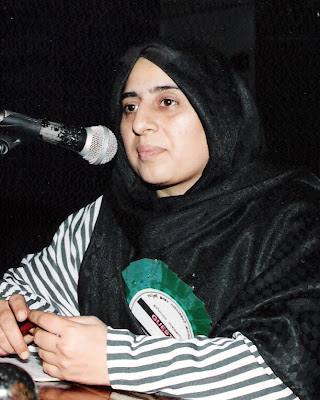
Uzma Naheed speaking to TwoCircles.net